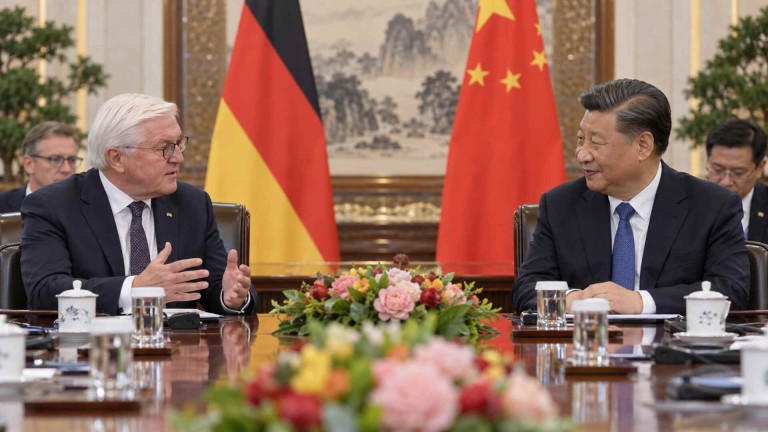
In a significant move to boost international economic stability, Chinese President Xi Jinping and German President Frank-Walter Steinmeier held discussions in Beijing on Friday, focusing on strengthening the strategic partnership between their nations. Xi expressed China’s commitment to enhancing bilateral relations and opening a new chapter in their comprehensive strategic partnership.
During the meeting, Xi underscored the importance of collaboration between China and Germany, highlighting their roles as major global economies. He called for stronger communication, mutual respect, and strategic cooperation, urging both sides to embrace openness and partnership over isolation and confrontation. Xi pointed out the complementary strengths of the two economies, with Germany’s expertise in advanced manufacturing and high-quality products aligning with China’s modernization efforts and high-quality economic development.
Xi encouraged German businesses to expand their investments in China, taking advantage of its large consumer market. He also urged Germany to provide Chinese companies operating in the country with a fair, transparent, and non-discriminatory business environment. The leaders identified opportunities for collaboration in areas such as artificial intelligence, green technology, low-carbon development, digital services, and the digital economy to enhance future competitiveness.
Moreover, Xi highlighted the significance of cooperation in education, culture, tourism, and people-to-people exchanges, particularly as the 55th anniversary of diplomatic relations between China and Germany approaches in 2027. On the topic of China-European Union relations, Xi reiterated Beijing’s position that cooperation should take precedence over competition, expressing hope for strengthened dialogue and a more balanced international order.
German President Steinmeier, acknowledging China’s economic and technological growth, reaffirmed Germany’s commitment to the One-China policy and expressed optimism about the future of bilateral relations. He emphasized that economic and trade disagreements should be addressed through dialogue and consultation, and pledged Germany’s readiness to collaborate with China to support international peace, free trade, and the principles of the United Nations Charter and international law.
The meeting also underscored the shared interest of China and Germany in opposing protectionism and trade conflicts amid growing pressures on the international economic and political order. Both leaders agreed on the importance of maintaining international stability and expanding diplomatic engagement in response to changing global conditions.