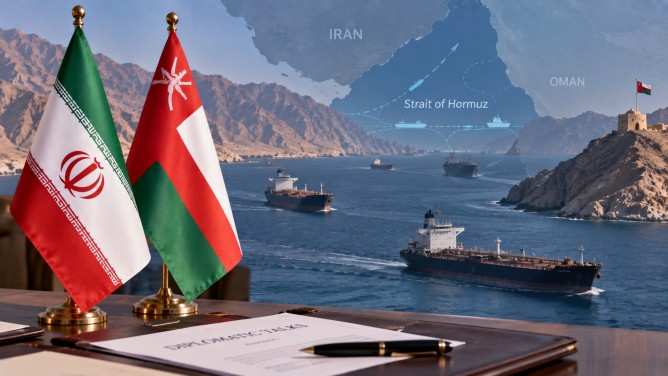
A crucial meeting involving Iran, Oman, and other Gulf nations to discuss new shipping protocols through the Strait of Hormuz has been delayed indefinitely, with no new date provided. Originally slated for Muscat, the discussions were set to address regional security concerns and the Iran-Oman initiative aimed at managing commercial shipping in this strategically vital waterway. Oman’s Foreign Minister Badr Albusaidi mentioned that the postponement was a strategic decision to foster consensus among the involved parties. Iran corroborated this, stating that the decision was made in concord with Oman after several regional countries requested the delay.
The decision to postpone came in the wake of an incident involving an Iranian commercial vessel reportedly attacked near Qeshm Island. Iranian state media reported one casualty and injuries to four crew members, while maritime authorities confirmed that the vessel was struck by a projectile in the Strait of Hormuz, leading to a fire and subsequent crew evacuation. This incident has heightened the urgency of addressing the safety and security of shipping routes through the strait, a critical channel for global oil shipments.
Previously, Iran and Oman had deliberated on alternative shipping routes through the Strait of Hormuz. The proposal involved inbound vessels navigating through Iranian waters, while outbound vessels would utilize both Iranian and Omani waters. Despite these discussions, Iran has underscored that any reopening of the strait hinges on fulfilling its stipulated conditions, hinting at potential charges for vessels using the proposed routes. Meanwhile, commercial traffic through the strait remains significantly curtailed, impacting global energy markets.
The postponement occurs amid broader diplomatic strains in the Gulf region. Saudi Arabia has expressed interest in modifying the proposed Iran-Oman arrangement, while Bahrain has opted out of participating in the meeting. The ongoing uncertainty surrounding the Strait of Hormuz is also contributing to a surge in oil prices. Compounding the issue, Saudi Arabia has maintained the closure of its 1,200-kilometer East-West oil pipeline following recent drone strikes, thereby constraining alternative routes for moving crude oil to the Red Sea.
The continued closure of this key pipeline, coupled with reduced shipping through the Strait of Hormuz, poses a significant risk to global oil supplies. These developments have already driven Brent crude prices to surpass $100 per barrel, as regional tensions escalate and the impact on energy markets becomes more pronounced.