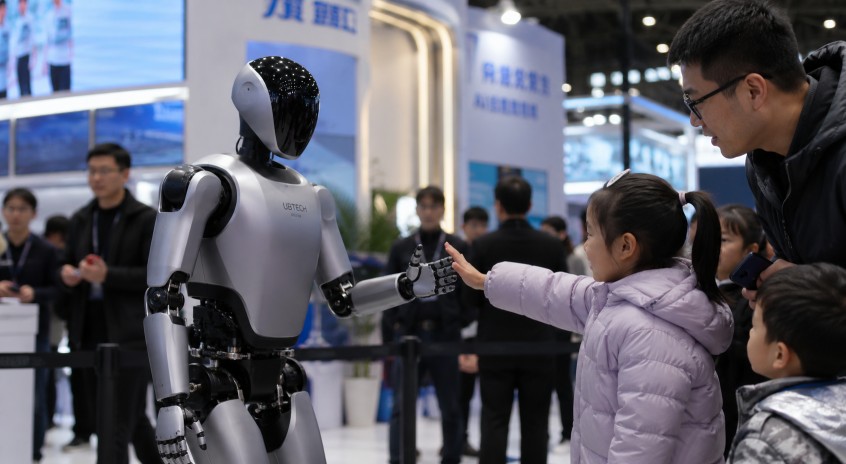
Over the past two decades, China’s robotics industry has experienced a significant evolution, transforming from rudimentary remote-controlled devices to sophisticated systems capable of making autonomous decisions and collaborating in real-world settings. This progression underscores the country’s commitment to technological advancement, as intelligent machines become integral to various sectors.
The journey of China’s robotics industry can be traced back to 2007 with the introduction of the i-Sobot, a compact robot developed in Dongguan, Guangdong Province. Despite its modest size, the i-Sobot could execute approximately 240 distinct movements, including walking and climbing, marking an early milestone in the country’s foray into intelligent robotics.
What started as a pioneering innovation has burgeoned into a flourishing industry. Today’s Chinese robots are equipped with artificial intelligence that allows them to sense their environments, make independent decisions, and collaborate with humans across diverse settings. This technological prowess is being harnessed beyond research facilities, with robots increasingly deployed in manufacturing, logistics, healthcare, public services, and everyday life.
The advancements in robotics are a crucial component of China’s economic strategy to cultivate “new quality productive forces,” emphasizing technological innovation, increased productivity, and high-quality industrial development. As these intelligent machines continue to expand their capabilities, they play a pivotal role in supporting the nation’s push for integrating automation across industries.
China’s rapid strides in the robotics sector highlight its growing investment in cutting-edge technologies and its ambition to integrate intelligent automation into the fabric of daily life and future economic expansion. As robots become more prominent in everyday activities, they symbolize the country’s broader aspirations for technological leadership and sustainable growth.