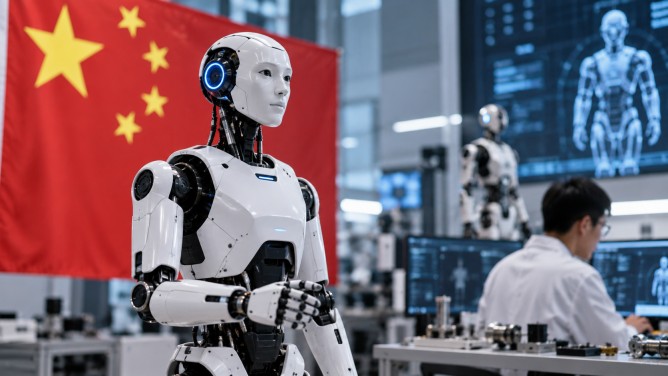
The humanoid robotics sector is nearing a significant milestone as Chinese firms continue to make swift advancements in the field of embodied intelligence. This progress was showcased at the recent World Humanoid Robot Games held in Beijing, where Chinese-developed humanoid robots exhibited remarkable abilities across various sporting events. Notably, some robots even exceeded existing human records, including the 9.58-second 100-meter sprint achieved by Usain Bolt and the 43.03-second 400-meter record set by Wayde van Niekerk.
Such rapid developments have heightened the competitive landscape among Chinese robotics companies and professionals, all vying for a leadership position in this burgeoning industry. These advancements have also sparked discussions about whether humanoid robotics is on the brink of its own “iPhone moment”—a term popularized by Nvidia CEO Jensen Huang in 2023. This term describes a pivotal technological breakthrough that propels an innovation from an emerging concept to broad acceptance, reshaping industries and user experiences in the process.
Wang Xingxing, founder and CEO of Unitree Robotics, a leading Chinese humanoid robot manufacturer, shared his views on when such a breakthrough might occur. He predicted that embodied intelligence could reach a pivotal point akin to the emergence of ChatGPT within two to three years. However, he also cautioned that under a slower development trajectory, it might take five to ten years to achieve this transformation.
Wang made these remarks during the 2026 World Robot Conference in Beijing on August 20. The timing of his comments was particularly significant, as they came just a day after Unitree Robotics made a striking debut on the Shanghai Stock Exchange’s STAR Market, where its shares surged by an impressive 460 percent by the close of trading.