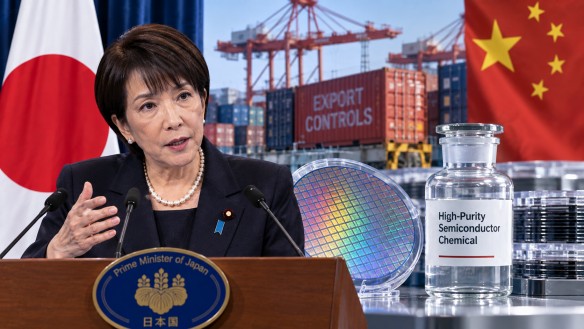
Japan has lodged a protest against China’s recent decision to enforce new export restrictions on dichlorosilane (DCS), a chemical crucial in the manufacture of semiconductors. This move by China has prompted Japan to evaluate the potential repercussions on its companies, including major exporters like Shin-Etsu Chemical and Denal Silane.
The new regulations require Chinese importers of Japanese DCS to provide cash deposits that could reach as high as 99.2%. These restrictions come in response to an anti-dumping investigation, where China claims that Japanese DCS exports have adversely affected its domestic industry. While these measures are currently provisional, a definitive ruling is anticipated following the conclusion of the investigation.
In response, Japan’s government has called on China to ensure that these measures do not unjustly harm Japanese businesses. Additionally, Japan has expressed its readiness to take appropriate actions should these restrictions prove detrimental. This development occurs amidst escalating tensions between China and Japan, particularly due to Japan’s stance on Taiwan.
Beijing has also implemented other trade and export limitations concerning Japanese firms and products that have dual-use capabilities, potentially applicable in military contexts. These additional restrictions underscore the broader economic friction between the two nations.
DCS plays a vital role in the semiconductor industry, where it is used to form ultra-thin layers of silicon and other materials on computer chips. Given Japan’s status as a leading producer of ultrapure DCS, the newly imposed restrictions by China could have significant implications for the global semiconductor supply chain.