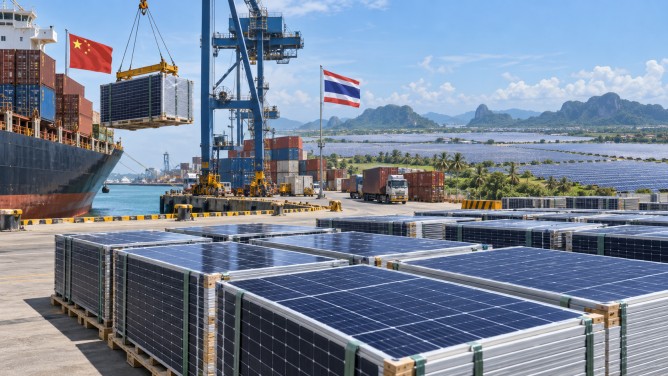
Thailand’s ambitious move to slash household electricity costs and bolster its clean energy sector is underscored by an 88.7% surge in solar panel imports, reaching $426.7 million in the first seven months of 2026. This spike is primarily fueled by imports from China, which accounts for a staggering 99.3% of Thailand’s solar panel market, according to data from the Ministry of Commerce and Customs Department.
The increase in imports aligns with Thailand’s rollout of a household solar installation program, set to subsidize the cost of solar panels by approximately THB50,000 per household. Initially targeting one million households, the initiative has the potential to expand to 1.5 million, aiming to incentivize rooftop and ground-mounted solar installations nationwide.
As part of its broader strategy to develop a domestic clean-energy supply chain, the Thai government is exploring various measures. These include collaborating with the Ministry of Labour on training programs for solar panel assembly, installation, and maintenance. Furthermore, discussions with the Board of Investment are in progress to potentially lower duties on production inputs that are not available locally, in a bid to stimulate domestic solar manufacturing.
The reliance on Chinese imports highlights the current limitations of Thailand’s domestic solar production capabilities. Aside from China, other suppliers such as Singapore and Hong Kong play a minimal role, each contributing roughly 0.3% to the total import value. This dependency underscores the necessity of Thailand’s efforts to cultivate its own solar industry infrastructure.
Ultimately, Thailand’s push towards solar energy is not just about reducing electricity bills for households but also about establishing a more sustainable and self-reliant energy future. By fostering a homegrown solar industry, Thailand aims to create jobs, build expertise, and secure its energy independence in the long run.