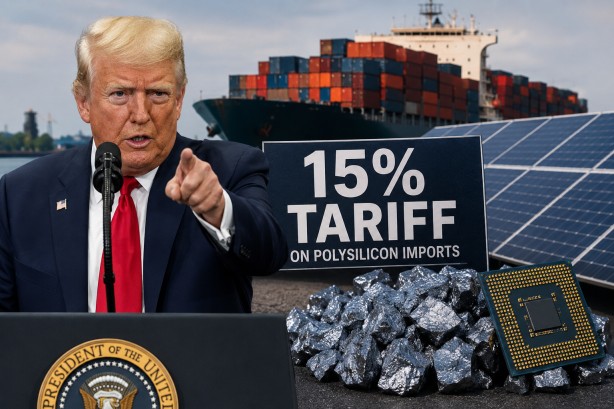
In a move aimed at bolstering domestic production and reducing dependency on Chinese imports, U.S. President Donald Trump has announced a 15% tariff on products made with polysilicon, a crucial component in the manufacturing of semiconductors and solar panels. This tariff is scheduled to be implemented on December 4. Polysilicon, an ultra-pure form of silicon, is essential for producing semiconductors that power artificial intelligence systems and data centers, as well as solar cells and panels. China currently dominates the global production of this material.
To further support these efforts, the new policy stipulates minimum import prices: $21 per kilogram for polysilicon, $100 per kilogram for polysilicon ingots and wafers, $0.22 per watt for solar cells, and $0.38 per watt for solar modules and panels. The U.S. administration has emphasized that these measures are critical to ensuring the commercial viability of domestic polysilicon production and to reinforcing supply chains that are vital to both economic and national security.
China has expressed disapproval of the tariff, accusing the United States of improperly using national security justifications to limit Chinese business operations. Chinese officials have warned that such protective measures could lead to disruptions in trade between the two countries. Despite these concerns, the U.S. remains focused on its strategy to boost internal production capabilities.
Currently, the United States houses two major polysilicon production facilities, managed by Hemlock Semiconductor in Michigan and Wacker Chemie in Tennessee. In addition to the tariff, the new policy allows for the establishment of incentives designed to encourage companies to invest in domestic polysilicon and related manufacturing infrastructures. These initiatives are seen as essential to strengthening the U.S. position in high-tech manufacturing.
The tariff decision comes amid a period of robust growth in Chinese exports, particularly in sectors like electronics and artificial intelligence-related products. As the U.S. takes steps to secure its own production capabilities, the global trade landscape, especially in high-value manufacturing, remains closely watched.